
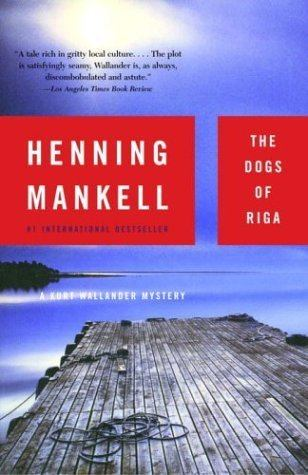
As primarily a literary fiction reader, with a few forays into spy novels (Le Carre) or detective novels (Christie), and whole lot of TV spy/police procedurals under my belt, the overriding impression for me is that this is a Kafkaesque tale of Wallander losing his relatively innocent and privileged Western outlook on life rather than a traditional cop story. Ironically–and this is what I found least believable–as a policeman W is rather naive, cloistered, even, about post-Soviet Baltic politics but even more so about the Latvian police corruption he is confronting. He just isn’t very shrewd at first when dealing with the two antagonists. For this reason, I consider the book not about policing itself but about policing as a pretext for Mankell to explore the experience of perdition, the being trapped in a labyrinth (a consistent trope for Riga and the case itself) and having to make one’s way out using one’s wits. The reality in Latvia circa 1990, in which people can be summarily abducted and killed, destroys W’s psychological bubble created by the safety and security of Swedish society; he is forever changed, a fall from innocence. Complicating this, of course, is the theme of doubling–two victims, W and his Latvian counterpart, Liepa, the two antagonists (Liepa’s superior officers), and of course the East/West doubling in which the East is the shadow of the West, and vice versa. W is “shadowed” by “dogs”–the incidence of the word shadow increases as the novel progresses–but he is also doing the shadowing of the perpetrators, he is his own shadow self. This picks up Le Carre’s theme of the dark side of the West.
I liked this aspect of the novel, which elevated it to an existential human drama beyond genre; it reminded me of when I traveled to Pinochet’s Chile as an exchange student. This may turn off readers looking for a more traditional procedural, of course.
The Branagh TV version does not do any of this justice. To convey the sense of perdition and gloom required a much more aesthetically oriented interpretation.
The Branagh TV version does not do any of this justice. To convey the sense of perdition and gloom required a much more aesthetically oriented interpretation.
 Jana Giles