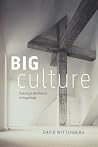
 Big Culture: Toward an Aesthetics of Magnitude by David Wittenberg
Two chapters in, I have a mixed reaction. Wittenberg is talking about what has historically been called the sublime, and what Tim Morton calls hyperobjects, but with a very big caveat that he establishes, just not very explicitly. He is talking about “representation,” or “image” (the latter term being ambiguous, since it is not always clear if he means an image as cultural artefact or a mental image) and his examples, so far, are all confined to either human artefacts, or else domestic nature (a cow perceived by a child). He is not, so far, addressing Kantian sublimity with regard to what Kant called “raw” nature. While I agree with Wittenberg’s premise that everything big is small, in the sense that if we can perceive an object qua object it must conform to human scale, we still do perceive “things”–perhaps not as “objects”–that challenge that human scale. Thus, notably, Wittenberg talks about the optical illusion of bigness created by the makers of Star Trek in the opening minutes, but not about the “bigness” of space itself, which is perceived and yet not comprehended. By the time the spaceship passes our eyes on screen, we have had a sense of sublimity, and yet also we know it’s a spaceship because ultimately we see the entire object pass before our eyes (and culturally we know what a spaceship is). This is what I would call “picturesque,” not sublime. It is a framed, delimited representation that represses the observer’s fear. That is indeed what art does, so no objection there. However, I am dissatisfied with Wittenberg’s sleight of hand insofar as anyone unfamiliar with the history of aesthetics is not going to understand where his intervention lies in relation to other theory. But it’s early days. On to chapter 3.
View all my Goodreads reviews
Aesthetics, Art, Humanities, Philosophy, The sublime
David Wittenberg’s Big Culture: Chs. 1-2


